Inside the Lanai Doors system
Strut vs. pour-and-debridge: the thermal break inside your doors.
Comfort starts with a barrier to heat flow. A well-designed folding door also needs strength and careful control of thermal movement.
There are two common ways to create a thermal break in an aluminum door or window: an insulating strut connecting separate aluminum sections, or a polymer poured into a channel that is later debridged. Lanai Doors uses pour-and-debridge in its thermally broken aluminum door panels and strut thermal breaks in its thermally broken standard threshold.
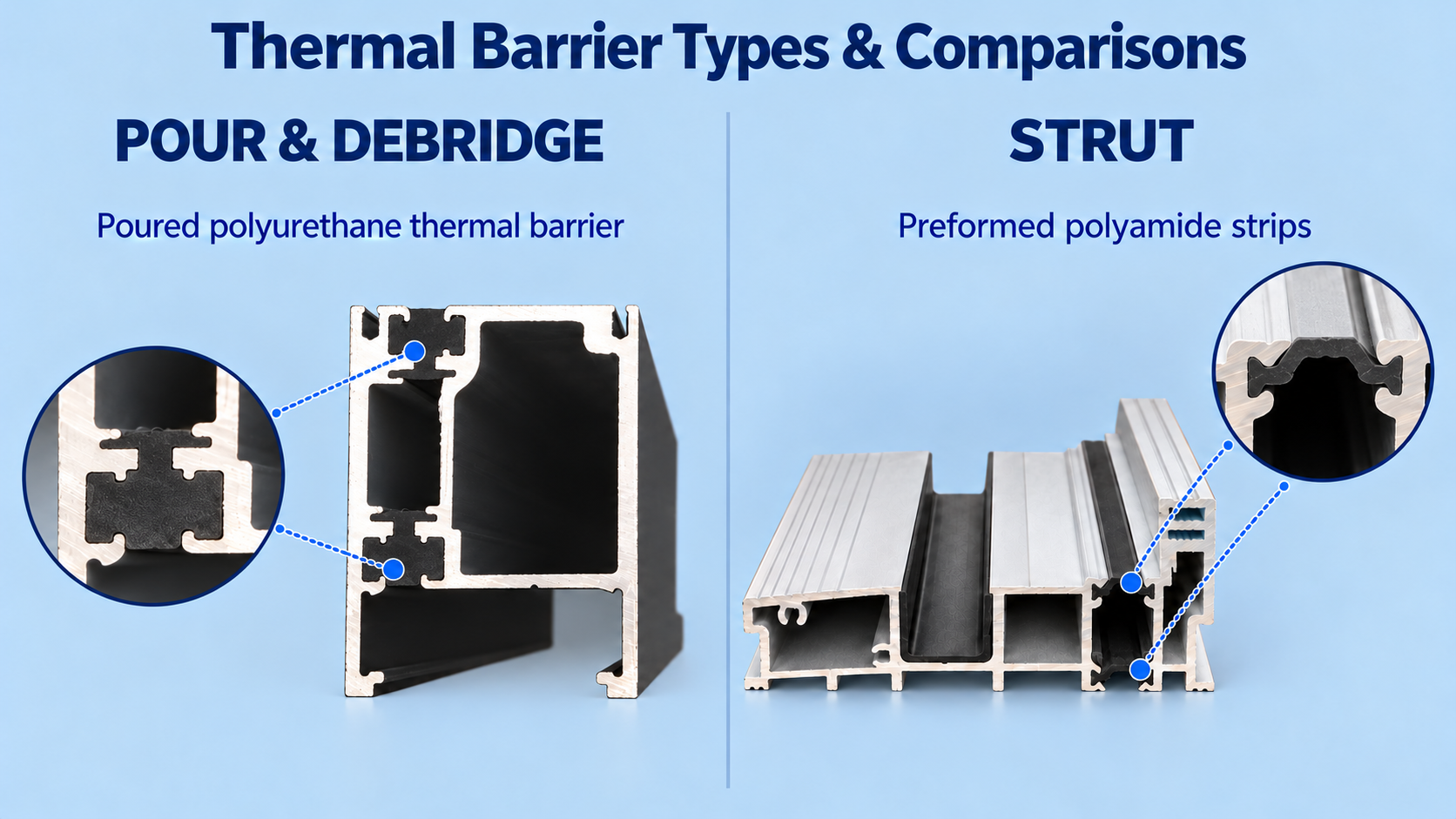
1. Strut: an insulating connection between two sections.
A strut system typically uses preformed polyamide insulating strips fitted into grooves in separate interior and exterior aluminum profiles. The aluminum is mechanically crimped or rolled around the strips to hold the assembly together.
In Lanai Doors’ thermally broken standard threshold, strut connections interrupt the metal path for heat transfer while connecting the aluminum sections. Their geometry, material, assembly, and quality control all influence the finished system. Strut systems come in many designs, including versions developed specifically to accommodate differential thermal movement.
2. Pour-and-debridge: pour, cure, then remove the metal bridge.
In a pour-and-debridge system, a two-part polyurethane is poured into a purpose-designed channel in an aluminum extrusion. Once the polymer has cured, a section of aluminum at the base of the channel is mechanically removed. That removal—the debridging step—interrupts the continuous metal path between the interior and exterior sections.
The cured polymer remains as the insulating connection. The channel design, polymer retention, processing, and quality control help the finished profile provide both thermal separation and structural performance.
| Detail | Strut | Pour-and-debridge |
|---|---|---|
| Insulating connection | Preformed strips, typically polyamide | Polyurethane poured and cured in a channel |
| How it is assembled | Separate metal sections mechanically secured to the strips | Polymer cures before the metal bridge is removed |
| What to evaluate | Strip design, mechanical connection, and complete-system testing | Channel design, polymer retention, and complete-system testing |
| Where Lanai uses it | Thermally broken standard threshold | Thermally broken aluminum door panels |
Why Lanai Doors chooses pour-and-debridge for its panels.
Lanai Doors selects pour-and-debridge for its aluminum panel profiles to support a strong connection and help resist thermal distortion. Its thermally broken standard threshold uses struts, reflecting the different role and design of that component. The goal is practical: combine thermal separation with structural integrity and dependable operation.
For homeowners, the benefit is a system designed around both comfort and everyday use. For contractors, it is a reason to look beyond the words “thermal break” and review how the complete door is built, supported, installed, and tested.
The method matters. The complete design matters, too.
Pour-and-debridge is not a guarantee against all thermal movement, and strut systems do not all perform alike. Comparisons of strength, distortion, or operating performance should be based on the specific profiles and tested door configurations.
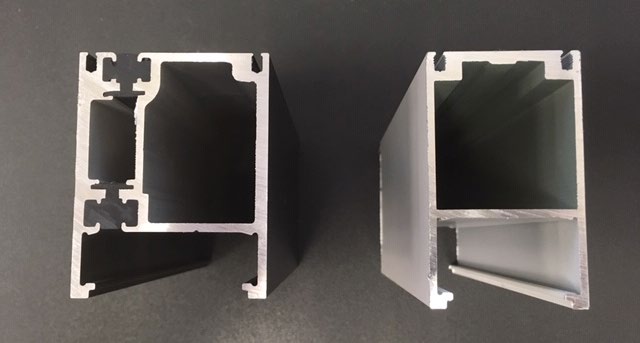
What is thermal twisting—and why can it affect a lock?
Aluminum expands as it warms. When direct sunlight heats the outside of a door more than the inside, the two sides can try to expand by different amounts. That difference can cause thermal bowing or twisting of the panel.
The panel may move differently from the jamb around it. If the lock or latch shifts relative to its receiver in the jamb, closing and locking the door can become more difficult. The jamb is not necessarily immovable; the concern is the difference in movement between the door and the surrounding frame.
Lanai’s choice of pour-and-debridge in the panel is intended to help resist this distortion. Hardware, panel size, finish, support, installation, and the temperature difference across the profile also play a part.
Plan for direct sun, not just the compass direction.
Lanai flags north- and west-facing installations that receive direct sun for particular review. West-facing openings can experience strong afternoon solar exposure. North-facing exposure depends on latitude, season, sun angle, and reflections from nearby surfaces; orientation alone does not predict thermal movement.
Any opening exposed to intense direct sun deserves a project-specific discussion. Dark finishes, large panels, shading, and a cool air-conditioned interior can change the temperature difference across the door.
- Share the opening’s orientation, location, shading, and direct-sun exposure.
- Discuss finish, panel dimensions, and the proposed thermal-break system.
- Coordinate jamb support, installation tolerances, and locking hardware.
- Ask about current performance information for the actual configuration.
Connect the construction to the comfort.
Want the everyday explanation of heat transfer, winter comfort, frost, and condensation? Read “What is a thermal break, and why is it important?” Then explore Lanai Doors’ thermally broken E+ Aluminum doors and windows for your project.
Discuss your opening with Lanai Doors ↗Technical background: AZON: pour-and-debridge process · Linetec: thermal pour and debridge · Technoform: thermal deformation and door locking. Profile photograph supplied by Lanai Doors.